





http://www.damninteresting.com/the-tyrant-clipperton-island/ – click on link to see website.
THE TYRANT OF CLIPPERTON ISLAND
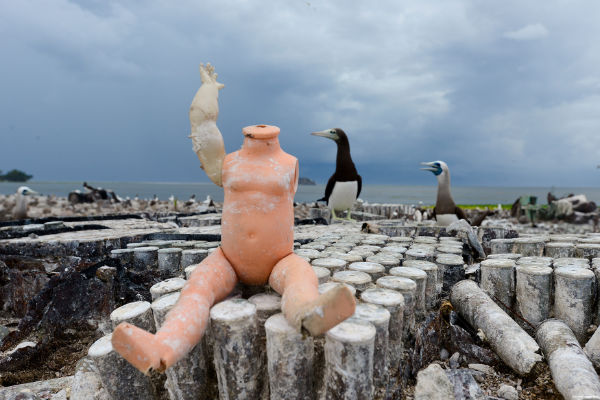
For a tropical island, Clipperton doesn’t have very much going for it. The tiny, ring-shaped atoll lying 1,000 kilometres off the southwest coast of Mexico is covered in hard, pointy coral and a prodigious number of nasty little crabs. The wet season from May to October brings incessant and torrential rain, and for the rest of the year the island reeks of ammonia. The Pacific Ocean batters the island from all sides, picking away at the scab of land that rises abruptly from the seabed. A few coconut palms are virtually the only thing that the island boasts in the way of vegetation. Oh, and the sea all around is full of sharks. It isn’t much of a surprise that Clipperton Island is decidedly uninhabited. This was not always the case, however. Over the course of the island’s modern history, four different nations–France, the United States, Britain, and Mexico–fought bitterly for ownership of Clipperton. It was desirable both for its strategic position and for its surface layer of guano, since the droppings of seabirds (as well as bats and seals) are prized as a fertiliser due to their high levels of nitrogen and phosphorus. Each of the four countries in turn attempted to maintain a permanent presence on Clipperton between 1858 and 1917. When a contingent of Mexican settlers did finally gain a toehold on the atoll, they were forgotten and left stranded on the island with a delusional man who seized the chance to become a dictator.
The island’s English name comes from a tenuous association with a British pirate, but the first modern explorers to claim Clipperton were the French, in 1858. Their intention was to land on the island’s shores and read out a proclamation, but this proved to be difficult; approaching the island with the ship posed a significant risk of running aground on the coral reef, and smaller rowboats were thwarted by sharks and fickle tides. Desperate, the French resorted to sailing around the perimeter of the island while reading the proclamation out to its coastline. Then, satisfied, they departed. Although they were aware of the guano, they felt it was likely to be of inferior quality, so they left it at that. The next country to claim the island was the United States, in 1892. Unlike the French, the Americans suspected that Clipperton’s guano was extremely valuable, and they annexed the island under the auspices of the U.S. Guano Islands Act. A small crew of American miners spent the next few years on the island attempting to turn a profit, but poor market conditions and expensive resupply-trips intervened. Then, in 1897, the Mexicans decided they’d had enough of the United States occupying an island so close to the Mexico coast. A small group of Mexicans sailed over, lured two of the three Americans away, and left a Mexican flag in place of the American one that had been flying from a forty-foot pole. The U.S. backed off and gave up its claim to the island, but France and Mexico were unable to come to an agreement. To complicate matters, an English company then decided to try a guano-mining operation of their own, insisting that they did not care who owned the island. Mexico allowed them to proceed. Governor Ramón Arnaud Sr
At this point there were approximately 26 people on Clipperton Island: 13 soldiers, about 12 women and children, and a reclusive lighthouse-keeper named Victoriano Álvarez who lived alone at the base of a sheer cliff below the lighthouse that the Mexicans had constructed in 1906. The island’s vegetable garden had been lost to the elements, and the only types of food available from the island itself were birds, bird eggs, and fish. There were also a few coconuts every week, but these were not a sufficient source of Vitamin C, and the islanders–especially the adult men–began getting sick with scurvy. One by one, they started dying; their fellow islanders buried their bodies deep beneath the sand in order to make them inaccessible to the crabs. Arnaud was mildly alarmed, but he was reluctant to abandon the island. At any rate, he knew that any attempt to reach the mainland would probably end badly; the one boat that the islanders owned did not have enough fuel for a trip over to Acapulco, and rowing it would be extremely difficult with only five men remaining on Clipperton, all of them suffering the effects of undernourishment and vitamin-deficiency.
Months passed, with Álvarez borrowing whichever female islander he wanted whenever he wanted: when he’d had enough of 20-year-old Altagracia Quiroz, he moved on to 13-year-old Rosalia Nava, and then 20-year-old Tirza Randon. The strong-willed Randon was far and away the most outspoken about her hatred of Álvarez, but was unable to think of a way to escape. “King” Álvarez was aware of the chance of being discovered by passing ships, especially since he knew that Alicia Rovira Arnaud would immediately tell all to any outsider who appeared. Consequently, Álvarez singled out Arnaud for threats, telling her that he would kill her the moment anyone from the outside world came into view.
Álvarez was almost certainly mentally ill. He had been belittled for much of his life on account of his African heritage, which was as stigmatised in Mexico as it was in the United States at the time. Years of isolation on Clipperton could only have amplified his anguish; lighthouse-keeping was notorious for causing madness.
Somehow, life at the colony went on for nearly two years under Álvarez’s reign of terror. The women and children divided up the coconuts and the leftover scraps of materials following the storm. Álvarez went on cycling through his trio of women. In the middle of July 1917, he got tired of Tirza Randon again, and decided that his next target was Alicia Rovira Arnaud, whom he had not pursued earlier. He picked up his rifle, took Randon back to the main settlement, and informed Arnaud that she was to present herself at his hut by the lighthouse the following morning. Sensing an opportunity, Randon informed Arnaud, “Now is the time.”
Arnaud met the Americans and frantically indicated the islanders’ desire to leave as soon as possible. Several members of the crew accompanied the women to the settlement in order to collect a few possessions, and others investigated the lighthouse. The Americans noted that the children were all small for their ages due to malnutrition; in particular, two-year-old Angel Arnaud was suffering from rickets and could not walk. Eleven-year-old Francisco Irra carried Angel on his back all the way to the American boat, and the sailors took the Clipperton Island survivors–three women and eight children–to the Yorktown. Álvarez’s body was left for the crabs.
Yorktown captain Commander Harlan Page Perrill later wrote in a letter to his wife:
I noted the women and some children gathering along the beach and you can imagine my surprise when the watchers on the bridge reported that they were getting into the boat. Speculation was rife. When Kerr got alongside and made his [oral] report, he revealed a tale of woe absolutely harrowing in its details.
Navigator Lieutenant Kerr’s official written report of the Clipperton Island rescue divulged no details whatsoever about the anti-social lighthouse-keeper; Kerr and Perrill were both eager to protect Randon and the other survivors from the potential legal and social repercussions of the final altercation between the women and Álvarez. For seventeen years, neither man would say a word about what had really happened on Clipperton Island between 1914 and 1917.
The Yorktown briefly suspended its German-hunting and set a course for Salina Cruz, Mexico, where a number of the women and children had family members. They sent ahead a wireless message to the British consulate in the city asking for help in locating relatives. The islanders all experienced some seasickness but liked the environment of the ship, and the sailors grew fond of the children. On 22 July 1917, the Yorktown reached the mainland.
Victor Emmanuel III of Italy finally made up his mind in 1931, awarding Clipperton Island to France. There have been occasional presences on the island since as the result of French/American military activities, scientific expeditions, and the occasional brief set of castaways. Ramón Arnaud Jr. even revisited the island with a team of biologists led by Jacques Cousteau in 1980; seventy-year-old Arnaud was pleased to see his place of birth in spite of the trauma. But no one has tried to live permanently on Clipperton since the last settlers were rescued by the Yorktown. Even without a crazed lighthouse-keeping rapist-tyrant, the island is very poorly equipped for comfortable human habitation.